

Client
Our client is a globally recognized pharmaceutical manufacturing and research organization with a strong presence in large-scale pharmacy healthcare. The organization operates within a highly regulated environment and places significant emphasis on compliance, data integrity, and financial governance. With multiple pharmacy and claims data systems supporting its operations, the client required a robust, scalable solution to monitor revenue risks and abnormal behaviours across its ecosystem.
Challange
Modern software development lifecycles (SDLC) suffer from fragmented tooling, siloed operational context, and heavy manual coordination across development, testing, release, and support phases.
Teams rely on multiple systems—JIRA for tracking, GitHub for code, Kubernetes for runtime, ServiceNow for incidents, observability tools for monitoring, and internal documentation for knowledge. This tool sprawl leads to:
- Slower Mean Time to Resolution (MTTR).
- Context loss between development, operations, and support.
- Manual handoffs across SDLC stages.
- Reduced developer productivity and delayed releases.
Despite automation tools, the lack of an intelligent orchestration layer prevents end-to-end SDLC optimization.
Our Solution
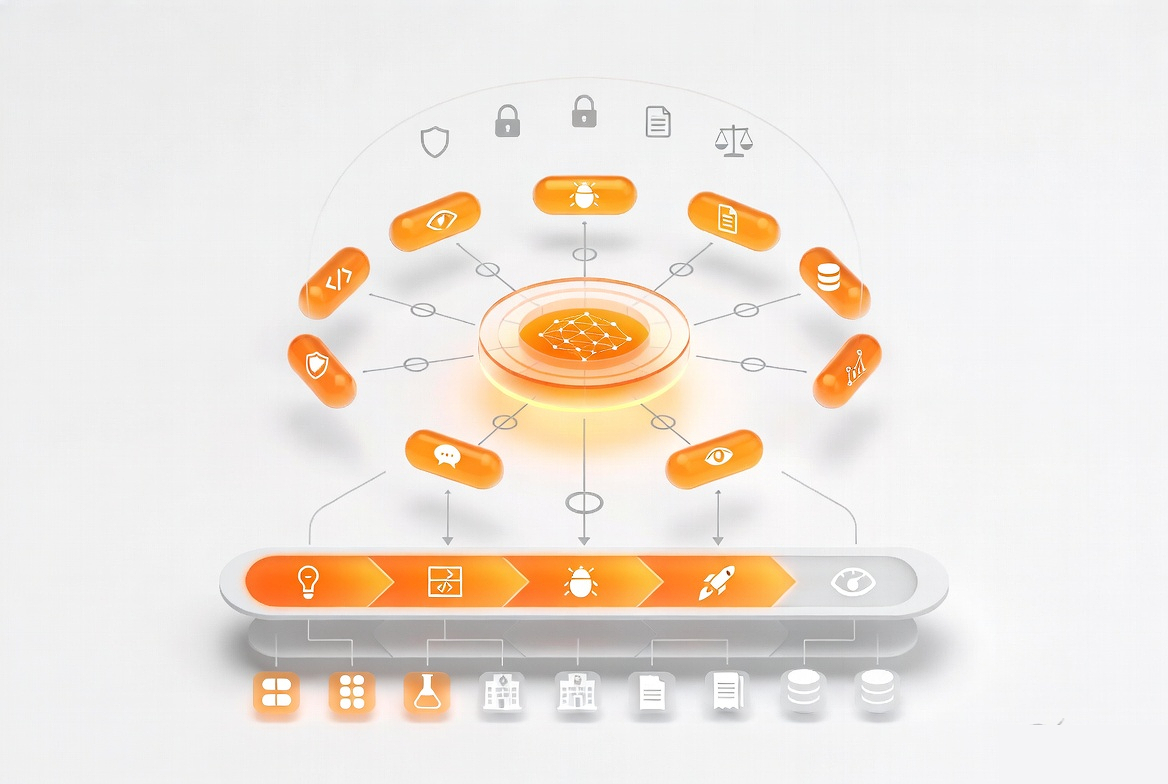
We implemented an Agentic AI–driven SDLC control plane powered by a Unified AI Supervisor Agent coordinating multiple specialized agents across the software lifecycle. This conversational, multi-agent system acts as a single intelligent interface that understands intent, plans multi-step workflows, routes tasks to the right agents, enforces guardrails, and resolves conflicts—enabling seamless SDLC execution from development to operations.
Features
AI Supervisor / Orchestrator Agent
- Single conversational interface for all SDLC interactions
- Performs intent classification, workflow planning, and agent routing
- Enforces safety guardrails and resolves cross-agent conflicts
SDLC-Specific Intelligent Agents
- JIRA Agent: Automated ticket creation, updates, duplicate detection, and contextual comments.
- GitHub Agent: Release summaries, version tracking, tags, and development insights.
- ServiceNow Agent: Incident creation, retrieval, SLA-aware troubleshooting.
- Kubernetes Agent: Read-only cluster visibility, runtime validation, platform insights.
- Observability & Troubleshooting Agent: Log analysis, error detection, root cause signals.
- RAG Agent: Instant access to internal SDLC documentation and platform knowledge.
- Reporting & Communication Agent: Auto-generated, customizable SDLC and operational reports.
- Feedback Agent: Captures and routes user feedback directly into tracking systems.
Workflow-Driven Execution
- Multi-step SDLC workflows executed autonomously across agents.
- Real-time data retrieval with human-in-the-loop validation when required
Business Outcome
- Accelerated SDLC Execution: Automated coordination across development, release, operations, and support reduces cycle time and MTTR.
- Single Source of Truth: Unified conversational interface eliminates context switching and tool-hopping.
- Improved Developer Productivity: Engineers focus on building software while agents handle operational and coordination tasks.
- Higher Service Quality & Reliability: Faster incident response, better observability, and proactive issue identification.
- Scalable Enterprise Adoption: Modular agent architecture allows seamless expansion across teams, tools, and platforms.
- Operational Cost Reduction: Reduced manual effort, fewer handoffs, and optimized resource utilization.
Tech Stack
- Agentic AI & Large Language Models
- Workflow Orchestration Platform
- Cloud & Containerized Infrastructure
- Enterprise SDLC Tool Integrations


