
We stand at the news point of the enterprise paradigm- one where business processes are not just workflows, but dynamic, autonomous agents with intent.
Agentic AI doesn’t merely execute instructions- it perceives context, plans, adapts, acts, and learns. This reimagining of flows as agents isn’t sci-fi. It is happening now, reshaping workflows from finance to frontline operations.
What is Agentic AI?
It is an autonomous artificial intelligence system that does not just respond to prompts- they act autonomously to achieve goals in dynamic environments. These systems break down objectives into sub-tasks, orchestrate workflows across tools, adapt to changing conditions, and enhance with time.
It represents an evolutionary leap from traditional RPA, which executes rigid, predefined rules to more adaptive context-aware automation for handling ambiguity and complexity.
Processes to Agentic flows
Reimagining flows as AI agents means centering business processes around autonomous goal-driven agents, not tasks. These agents:
- Perceive context– through data, events, systems.
- Plan and reason– through chain-of-thought or tree-of-thought technique.
- Execute tasks– by triggering APIs, RPA bots, or interacting with humans when required.
- Monitor and learn– refine strategy over the time.
Think of invoice processing that adapts to varying formats, identifies anomalies, triggers approval, and handles exceptions- all without any human intervention. Or imagine a multi-agent system managing ERP workflows- budgeting, reporting, wire transfers- achieving up to 40% faster processing, 94% fewer errors, and better compliance.
Real-world momentum
Some of the big consulting firms are betting big. Deloitte has Zora AI, and EY has EY.ai Agentic Platforms that enables autonomous agents for financial management, tax, and advisory services. This allows them to move from fee-for-hours to outcome-based models.
TechRadar frames the shift from reactive copilots to proactive ones, goal-driven agents that plan, decide, and act. In frontline operations- retail, manufacturing, logistics, agentic AI handles rescheduling, compliance actions, staff training, and optimization without waiting for human direction.
Benefits Unlocked
- Agility and resilience: Agentic systems adapt in real time—responding to new triggers or environmental shifts without being reprogrammed.
- Efficiency and scale: Autonomous agents scale without proportional human oversight. Multi-agent collaboration enables parallel execution- supercharging throughput.
- Error reduction & compliance: Engineered guardrails, context awareness, and orchestration help prevent failures and ensure regulatory alignment.
- Human-centric enhancement: Agents free humans from routine work- enabling them to focus on judgment, emotion, and innovation, especially in strategic operations.
Blueprint for Implementation
1. Define clear, high-value use cases
Start small- e.g., invoice processing, customer triage, maintenance scheduling. Choose flows with variability and multi-step decision logic to maximize gains.
2. Architect agentic systems
Combine:
- Perception (data/event triggers),
- Reasoning & Planning (LLMs using chain/tree-of-thought),
Execution (via RPA and APIs), - Memory (short- and long-term for context & learning),
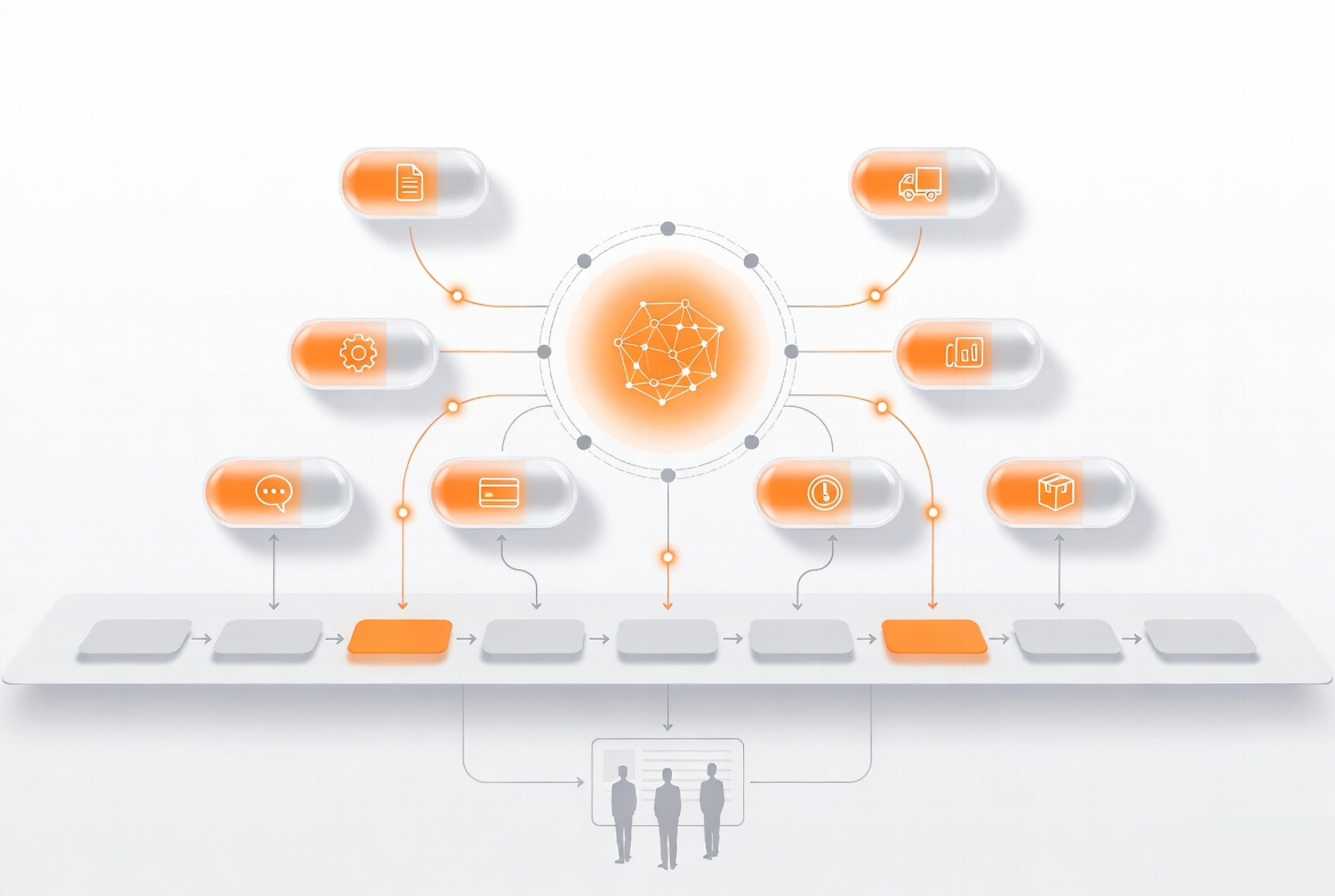
- Guardrails & orchestration (for governance and coordination).
3. Use multi-agent orchestration
Deploy specialized agents (sequential or parallel) that collaborate- much like team members- managed by a central orchestrator.
4. Blend human oversight
Design for human-in-the-loop when decisions hit pre-defined uncertainty thresholds. This builds trust and safety.
5. Measure and iterate
Gauge success via processing time, error rate, workflow autonomy, and human satisfaction. Scale iteratively, learning from agent behavior.
6. Guard ethically
Implement transparency, audit logs, bias mitigation, and security- especially as agents act with autonomy.
The Emerging Horizon
Academic research points to deeper paradigm shifts. Recent work advocates designing business process development not around tasks- but goals, agents, and business objects- yielding modular, intelligent workflows resilient to dynamic enterprise environments.
Generative Business Process AI Agents (GBPAs) for ERP (e.g., finance workflows) are being prototyped- showing concrete improvements in compliance, speed, and accuracy.
Organizations are treating agentic AI as the connective tissue of intelligent enterprises, not merely tools- but collaborators that reweave strategy into execution.
How Chimera Technologies Enhances Agentic Workflow Design?
Chimera’s strengths map directly onto the agentic flow architecture:
- Building Agentic Workflows & Enterprise Agents: With expertise in creating agent-powered workflows and deploying AI copilots/agents, Chimera helps firms automate complex, multi-step processes- ensuring agents handle context, decision logic, and execution intelligently.
- Conversational Multi-turn Bots for Process Orchestration: Their multi-turn bots retain context across interactions- ideal for coordinating tasks, seeking human input when needed, and guiding agents through conditional logic.
- Advanced Data Handling, AI, and ML: Skilled in working with both structured and unstructured data, ML pipelines, predictive analytics, and personalization, Chimera enables agents to interpret complex datasets and make reasoned decisions.
- Prompt Engineering & Responsible AI: Through fine-tuned prompts, structured responses, and AI ethics frameworks, they help build agents that remain transparent, accurate, and guardrailed.
- Low-Code/No-Code & Rapid Prototyping: For enterprises scaling agentic systems, Chimera’s low-code platforms and rapid prototyping enable faster deployment, iterative experimentation, and easier adaptation.
Conclusion: From Process to Purpose
In this agentic era, business flows become agents- not just conveyors of work, but autonomous collaborators with goals, context, and capability to learn. They transcend automation; they enact intelligence.
To succeed, organizations must shift their mindset: design workflows as ecosystems of agents, integrate guardrails and human oversight, and invest in orchestration and continuous learning. The frontier is no longer “can AI help us?” but “which processes will we empower with agency next?”
From invoice ops to frontline staffing, agentic AI is redefining work itself- embedding intelligence, autonomy, and adaptability right into the fabric of enterprise flows.