
Artificial Intelligence (AI) and Machine Learning (ML) are emerging as the foundations of the health care innovation of the present day. The technologies are revolutionizing the way physicians reach out to diagnose a particular illness, how patients are treated, and how hospitals work. AI and ML are making the healthcare system smarter and more efficient through the way it improves diagnosis accuracy, predicts health risks before they occur, and accurately predicts the patient.
AI in the medical sector is a fast-rising business in the world which is anticipated to reach up to 187 billion by 2030. This expansion is an indication of the relative importance of such technologies in the future of medicine. Healthcare providers, researchers, and policymakers are now appreciating the fact that AI and ML are no longer a tool but a partner that will enhance patient outcomes and save lives.
AI in Diagnostics and Early Detection
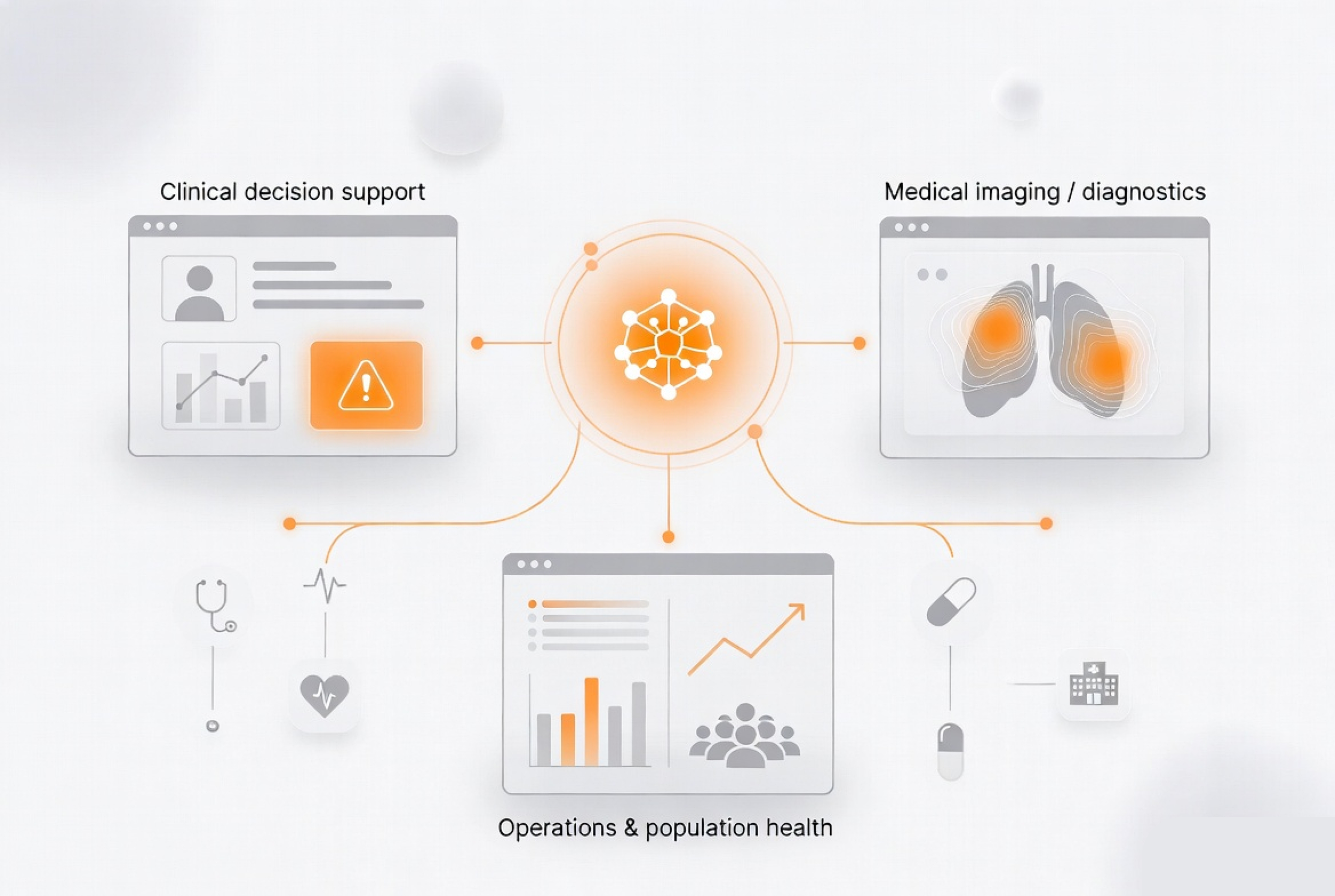
The diagnostics and early disease detection are one of the most influential applications of AI in healthcare. Conventional diagnostic measures usually entail such practice as the manual analysis of scans, laboratory tests, and patient records. This data can also be analyzed more quickly, more precisely, and with fewer mistakes with the help of AI-driven systems.
AI-based imaging features, e.g. are currently considered to be applied to screen cancers, heart diseases and neurological states. Such systems rely on deep learning algorithms to detect patterns on the medical images -patterns that may not be visible to the human eye.
One famous case is that of DeepMind at Google that created an artificial intelligence (AI) model that could identify more than 50 kinds of eye diseases using a retinal scan. The system was equally effective or better, as the expert ophthalmologists, besides the ability to detect the issues earlier, providing the patient with a greater chance at a successful treatment.
ML in Personalized Medicine
Machine Learning is transforming the concept of personalized medicine, which allows planning the treatment plans of individual patients and creating them according to their personal features – genetics, way of life, and environment.
ML algorithms do not consider a single treatment that fits all patients, instead they use large volumes of genetic and clinical data to tell which therapies will be most effective on a particular patient. This facilitates more effective treatments and eliminates the trial and error approach which has been identified to be very slow in bringing back the recovery.
As an example, ML models can examine the genetic profile of a cancer patient to predict his or her response to various forms of chemotherapy. This assists physicians in making the most appropriate choice of treatment with the minimal side effects. On the same note, in pharmacogenomics, the study of the relationship between genes and response to drugs, ML is assisting researchers to create more accurate and safer drugs.
ML is as well enhancing chronic disease management. With the help of wearable devices, electronic health records, and lifestyle data, ML systems can estimate when a patient is at risk of having his/her conditions deteriorate.
Operational Efficiency
Clinical care is not the only area where AI and ML are changing the way healthcare is provided, but also the working efficiency of healthcare systems. The data generated in hospitals and clinics daily has enormous proportions, including appointment schedules and billing information. It may take time to manage these processes manually and be prone to errors.
AI-inspired systems are currently simplifying the work of hospitals as they help to optimize scheduling, resource distribution, and administration. An example is that machine learning algorithms can forecast the movement of patients, and assign staff members more effectively, which will save on waiting time and overcrowding problems.
Claims automation brought about by AI is also benefiting insurance and billing departments. Saving time through automatic processing of medical claims and auto-reviewing of the claims, AI will decrease the paperwork and minimize errors, accelerating the process of reimbursement to patients and providers.
Ethical and Regulatory Challenges
The data-intensive methodologies of AI and ML also present ethical and regulatory issues to consider. Data privacy is an enormous concern. Medical data, in particular, is very sensitive, and a result of breach of misuse of that data can be very harmful. Similarly to other businesses, employees in healthcare (whether they are a business owner, employee, etc.) need to comply with at least some regulations in order to protect patient information. In the United States, the healthcare industry has rules laid out by the ”Health Insurance Portability and Accountability Act” (HIPAA) that need to be followed.
The second issue is a bias in AI models. Generally, the training data used to build AI will have all similar data (homogeneous) and that can lead to incorrect or biassed against a group or groups. In advancing trust in our AI systems, this means ensuring data is representative and continually kept up to date.
For privacy and bias concerns researchers are beginning to look at federated learning to develop AI and ML so the training of AI is able to look at data from different sources, with the data staying at those different sources.
Conclusion
Rather than replacing doctors, AI and ML are enhancing doctor’s medical practice. These technologies improve human capabilities and make healthcare more accurate, more efficient, and more accessible. From screening for diseases in advance of illness, to managing treatment plans uniquely tailored for each person, to managing smarter hospitals and care facilities, AI and ML are changing every aspect of healthcare.
Healthcare’s future is intelligent, predictive, and patient-centered. Combine the power of data with the compassion of humanity, and the opportunity is creating a healthcare system that treats illness, but also prevents it, and helps people live longer, healthier lives.