
When we talk about the pharmaceutical world, data is everything- a lifeline and a bottleneck. Every new clinical trial, regulatory submission, and scientific publication adds to an ocean of unstructured information that researchers and compliance teams must use.
The challenge here is?
Most of this data is hidden in long, never ending documents, scattered across different complex formats, and expressed in technical and domain-specific language.
Relying on manual data extraction process not just slows down the drug development process and approval but also introduces some serious risks- human errors, compliance gaps, and costly delays. Missing a single regulatory detail means months of setbacks and millions in lost opportunities.
This is where AI powered Names Entity Recognition is transforming the landscape. By automating the data identification, and classification, AI makes it possible to extract meaningful insights at scale.
The data challenge in Pharma Life Science
The pharma industry generates a volume of unstructured data every hour. Some the relevant examples include:
- Clinical trial reports detailing dosages, outcomes, and patient responses.
- Regulatory fillings required by agencies like EMA or FDA.
- Scientific publications across multiple journals and languages.
- Patient case records from trials and hospitals.
- Real-world evidence collected from wearables, insurance claims, and surveys.
The challenge lies in the complexity. Pharma documents are filled with difficult terminology, technical language, and even multilingual content. Manually reviewing and extraction of this data is risky. Errors can lead to compliance violations, delay in approvals, and flawed research conclusions.
When stakes are this high, inefficient data handling not just waste resources but also affect patient safety, regulatory trusts, and business competitiveness.
AI and NER: What do they offer?
Named Entity Recognition is a subfield of Natural Language Processing that classifies the entities within text- like names, locations, dates, or domain-specific terms. In pharma, this means spotting critical deals like:
- Regulatory requirements and trial phase
- Patient demographics and biomarkers
- Side effects and adverse events
- Dosage
- Drug names
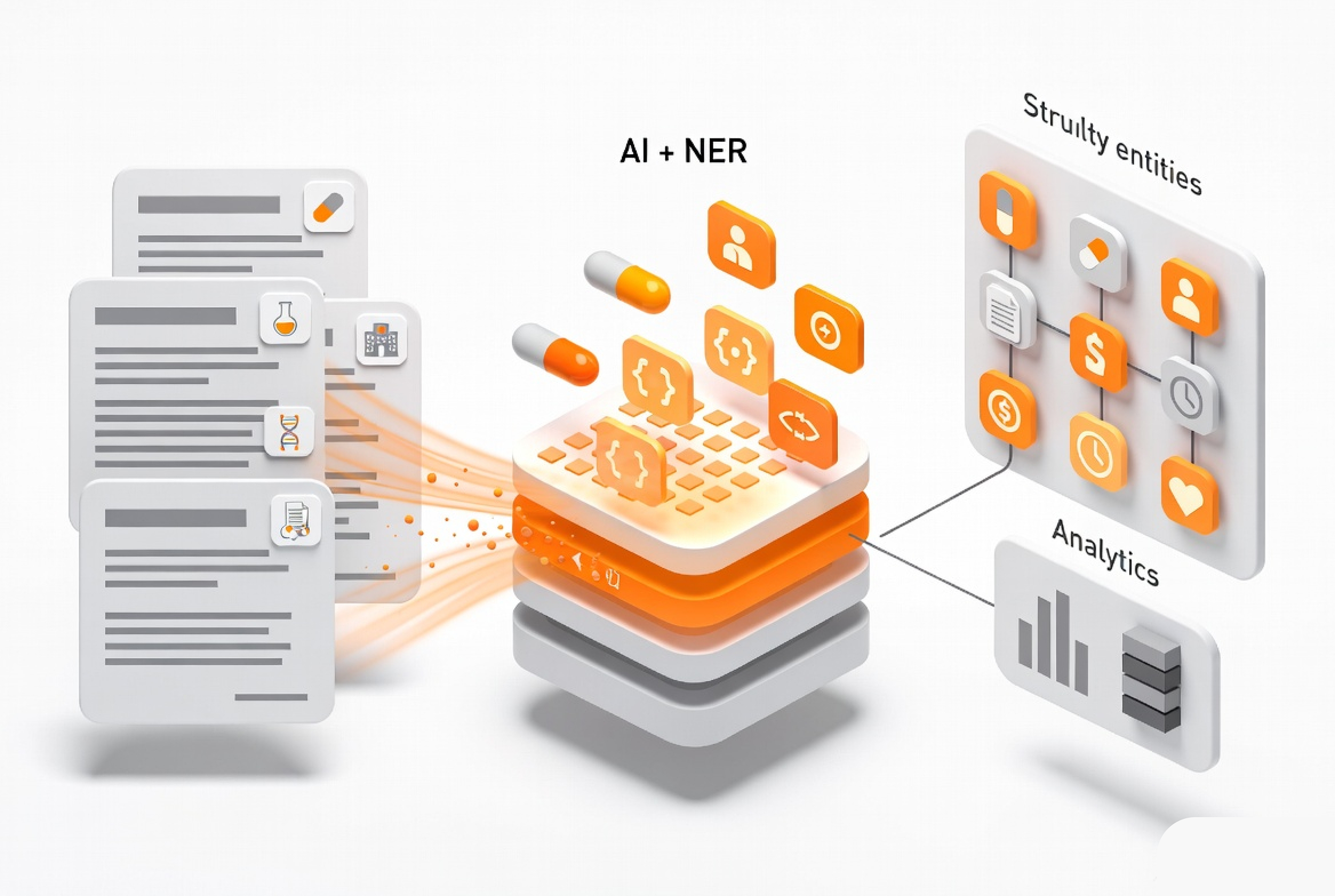
NER becomes one of the most powerful tools for pharma life sciences when combined with AI capabilities. They are trained on domain-specific datasets to interpret technical jargons, disambiguate terms, and recognize different patterns across a large set of data.
For instance, instead of manually scanning a 250 page trial report, AI+NER can extract dosage details, outcomes, and adverse events. These can then feed into compliance systems or research workflows.
Use Cases of AI-driven data extraction in pharma life science
The applications of AI-powered NER in pharma are vast and growing:
- Clinical trials- AI can be used to automate extraction of trial outcomes, patient responses, and events. This speeds up the reporting cycle and ensures data is consistently used.
- Drug safety- AI can be used to scan safety reports, patient records, and journals. These scanning with AI will help identify adverse drug reactions helping companies meet pharmacovigilance obligations.
- Regulatory submission- Companies can use AI for preparing compliance documents. It is no wonder a traditionally tedious process. AI here automates the work by pulling required data directly from trail reports.
- Medical research- Researchers can mine huge scientific literature to identify drug repurposing opportunities and uncover biomarker associations.
- Market access and real-world evidence- NER allows for faster extraction of payer-relevant data from patient registers or insurance claims.
Benefits of Automating Pharma Life Sciences Data Extraction
The impact of AI-driven automation in pharma data extraction is transformative:
- Speed and Scalability: Large volumes of documents can be processed in hours instead of weeks.
- Improved Accuracy and Compliance: AI reduces human error and ensures regulatory requirements are not overlooked.
- Cost Savings: Automation lowers reliance on manual labor and external consultants.
- Real-Time Insights: Data becomes instantly available for decision-making, helping organizations respond faster to regulatory queries or safety alerts.
In an industry where every day of delay can cost millions, these benefits are not just operational—they’re strategic.
Challenges and Considerations
While promising, AI-driven extraction comes with considerations:
- Domain-Specific Training: Generic AI won’t cut it; models must be trained on pharma-specific datasets.
- Data Privacy & Compliance: Handling patient records requires strict adherence to HIPAA, GDPR, and regional data laws.
- Ambiguous Terminology: Many medical terms overlap or have multiple meanings, requiring careful disambiguation.
- Human Oversight: AI accelerates processes, but final validation by subject matter experts remains essential for safety and compliance.
These challenges highlight the need for a balanced approach—AI for scale, humans for judgment.
Future Outlook: AI-Powered Pharma Life Sciences
The future of pharma Life Sciences is undeniably AI-driven. From drug discovery to market access, we’ll see deeper integration of AI tools across workflows. Explainable AI will become critical, ensuring transparency and regulatory acceptance. Real-time decision-support systems will emerge, where AI provides live insights during trials, submissions, or even patient consultations.
This evolution points toward a smarter, faster, and more resilient pharmaceutical ecosystem- one where data is no longer a barrier but a catalyst.
Conclusion
AI and NER are revolutionizing how pharmaceutical companies handle unstructured data. By automating extraction from trial reports, regulatory filings, and real-world evidence, they bring unmatched efficiency, accuracy, and compliance support.
For an industry where precision and speed can make the difference between approval and delay, these tools are not optional- they’re becoming essential. The future of pharma Life Sciences will be shaped by AI systems that turn overwhelming volumes of data into actionable insights, making the industry smarter, faster, and ultimately safer for patients worldwide.